

Buying an investment property often feels like a decision based entirely on numbers. Investors compare locations, calculate rental yields, review market trends, and carefully consider their budgets before making a commitment. On paper, it seems like a logical process where facts and figures naturally lead to the right answer.
In reality, investing is rarely driven by logic alone.
Even the most experienced investors experience moments of doubt, excitement, hesitation, and optimism. News headlines, conversations with friends, and stories of people making impressive returns can all influence how we feel about investing. Sometimes these emotions encourage us to act too quickly. At other times, they cause us to delay good opportunities because we’re afraid of making the wrong decision.
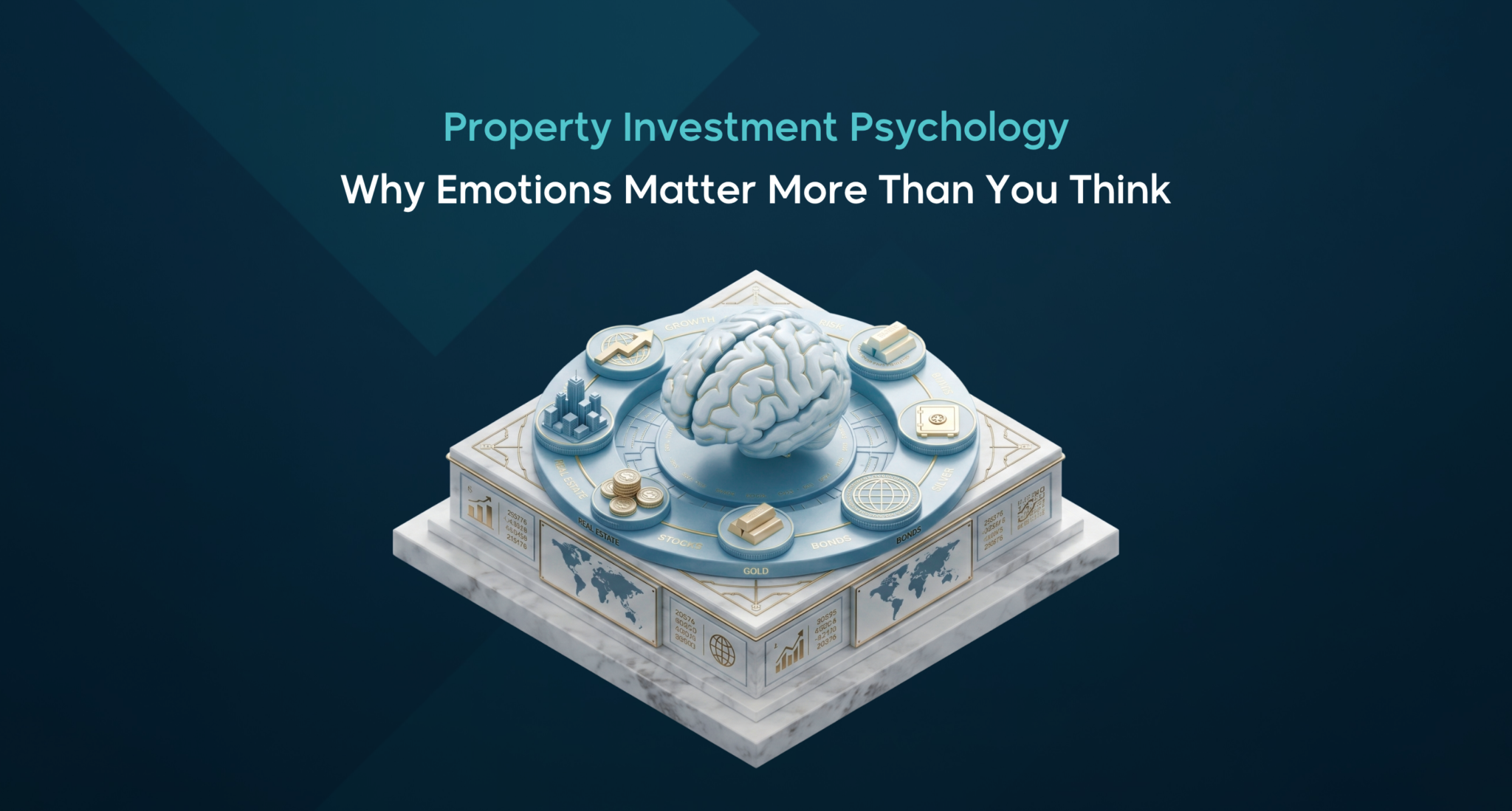
This is where property investment psychology becomes important. Understanding how emotions influence financial decisions doesn’t mean ignoring your instincts or becoming completely detached. Instead, it means recognising the common thought patterns that affect investors so you can make decisions based on research, planning, and long-term goals rather than short-term emotions.
Learning to manage these psychological influences is often just as valuable as understanding the financial side of property investing.
Why Emotions Play Such a Big Role in Investing
Money has always been closely connected to emotion. It represents security, opportunity, freedom, and, for many people, years of hard work. Because of this, every investment decision carries a degree of emotional weight, regardless of how experienced an investor may be.
Property investing adds another layer to those emotions because real estate is a tangible asset. Unlike shares or other investments that exist largely on a screen, property feels real. Investors can visit it, see it, and imagine its future potential. That emotional connection can sometimes make decisions feel even more personal.
It’s also natural to worry about making mistakes. Buying property usually involves a significant financial commitment, and nobody wants to look back wishing they had made a different decision. This uncertainty can lead investors to spend months researching opportunities without ever feeling completely ready to invest.
On the other hand, excitement can be just as influential. During periods of strong market activity, it’s easy to become caught up in optimistic forecasts and success stories. Hearing about someone else’s profitable investment can create the impression that every opportunity should be acted on immediately, even when it doesn’t align with your own financial goals.
Recognising these emotions isn’t a weakness. It’s simply part of being human. Good property investment psychology isn’t about eliminating emotion altogether. It’s about understanding when emotion is helping you make thoughtful decisions and when it may be clouding your judgement.
Common Psychological Biases That Affect Investors
Our brains naturally rely on shortcuts to help us make decisions quickly. While these mental habits can be useful in everyday life, they sometimes lead investors to make choices based more on emotion than evidence.
One of the most common examples is the fear of missing out, often referred to as FOMO. Imagine hearing that property prices in a particular area have risen significantly over the past year. Friends are talking about investing there, the media is reporting strong demand, and every article seems to suggest prices will continue climbing. The temptation is to invest simply because everyone else appears to be doing the same. In reality, successful investing is rarely about following the crowd. It’s about deciding whether an opportunity genuinely fits your own objectives.
Another common influence is loss aversion. Most people find the possibility of losing money more uncomfortable than the satisfaction of making an equivalent gain. This can make investors overly cautious, causing them to avoid opportunities that have been carefully researched simply because they cannot guarantee a positive outcome. While caution is healthy, allowing fear to dominate every decision can prevent long-term progress.
Confirmation bias can be equally misleading. Once we form an opinion, we naturally seek out information that supports it while paying less attention to evidence that suggests otherwise. An investor who has already decided that a particular suburb is the perfect location may focus only on positive reports while ignoring signs that rental demand is slowing or new developments are increasing supply.
There’s also recency bias, which leads people to believe that whatever has happened recently will continue indefinitely. If property prices have been rising steadily, it’s easy to assume they will keep increasing forever. Conversely, after a period of slower growth or negative headlines, some investors begin to believe the market will never recover. Neither assumption reflects how property markets actually behave. Markets move through cycles, and understanding those cycles often provides a more balanced perspective than reacting to short-term events.
None of these psychological tendencies are unique to inexperienced investors. They affect professionals, business owners, and seasoned investors alike. The difference is that experienced investors are often more aware of these biases and have developed processes to stop emotions from making decisions on their behalf.
How Successful Investors Stay Objective
The most successful investors aren’t necessarily those who can predict the market better than everyone else. More often, they’re the people who have developed the discipline to make consistent decisions even when emotions are running high.
One of the simplest ways to stay objective is to begin with a clear investment strategy. Investors who understand why they’re investing, how long they intend to hold an asset, and what they’re hoping to achieve are generally less influenced by short-term market noise. Instead of reacting to every headline, they measure opportunities against their own financial objectives.
Successful investors also recognise the value of research. Rather than relying on opinions or social media discussions, they evaluate location, rental demand, property fundamentals, and long-term trends before making decisions. Having objective criteria creates a framework that helps reduce emotional decision-making.
Perhaps most importantly, disciplined investors accept that uncertainty is part of investing. No one can predict the future with complete accuracy. Instead of waiting for the “perfect” time to invest, they focus on making informed decisions based on the information available, knowing that long-term success is built through patience and consistency rather than perfect timing.
How Fractional Property Ownership Can Encourage Disciplined Investing
One of the biggest challenges for first-time investors is feeling as though they need to make the perfect decision from the very beginning. This pressure can lead to endless research, second-guessing, or waiting for the “right” moment to invest. In reality, successful investing is rarely about perfection. It’s about making informed decisions and allowing time to do the heavy lifting.
Fractional property ownership can help reduce some of this pressure by making it possible to start building a property portfolio without purchasing an entire property outright. Rather than concentrating all your capital into a single investment, you have the opportunity to spread your investment across different assets as your portfolio grows. This encourages a more measured approach, where decisions are based on research and long-term objectives instead of emotion or urgency.
That doesn’t mean investors should lower their standards. Every opportunity should still be assessed carefully by considering factors such as location, rental demand, expected returns, and how the investment fits within an overall financial plan. The difference is that investors can often make these decisions with greater flexibility, reducing the feeling that every investment has to be an all-or-nothing commitment.
If you’re beginning your investment journey, our article “How to Align Real Estate Investments With Your Financial Goals” explains why having a clear strategy can make investment decisions more focused and consistent over time.
At Osool Gamma, we believe education is one of the most valuable tools an investor can have. Understanding property investment psychology alongside market fundamentals allows investors to make more confident, informed decisions. Through accessible fractional property ownership opportunities and investor education, Osool Gamma helps individuals participate in income-generating real estate while building knowledge that supports long-term financial goals. Where applicable, Osool Gamma’s offering is currently being tested within REGA’s Regulatory Sandbox, supporting innovation within Saudi Arabia’s real estate investment sector.
Building Confidence Through Knowledge
Confidence doesn’t come from predicting what the market will do next. It comes from understanding how to evaluate opportunities and trusting the process you’ve put in place.
The more investors understand concepts such as market cycles, rental yields, diversification, interest rates, and investment metrics, the less likely they are to react emotionally to short-term market movements. Knowledge provides perspective, making it easier to separate temporary uncertainty from genuine investment risks.
Objective data also helps reduce emotional bias. Instead of relying on opinions or market speculation, investors can assess opportunities using measurable criteria that align with their financial goals. Our article “The Most Important Property Investment Metrics Every Investor Should Know“ explains the key indicators that can help investors evaluate opportunities with greater confidence and consistency.
Investing will always involve uncertainty, but uncertainty becomes far easier to manage when decisions are supported by research rather than emotion. Investors interested in learning more about behavioural finance and the role psychology plays in investment decision-making can also explore educational resources published by the CFA Institute, which examine how cognitive biases influence financial decisions and how investors can develop more disciplined decision-making habits.
Successful Investing Starts With the Right Mindset
Every investor experiences moments of doubt, excitement, and uncertainty. The goal isn’t to eliminate those emotions but to recognise when they’re influencing your decisions.
Strong property investment psychology is built on preparation rather than prediction. Investors who take the time to develop a strategy, understand market fundamentals, and stay focused on long-term objectives are often better equipped to navigate changing market conditions without being distracted by short-term noise.
Markets will continue to change, headlines will come and go, and economic conditions will evolve. A disciplined mindset, supported by knowledge and careful planning, gives investors the confidence to make thoughtful decisions that reflect their financial goals rather than their emotions in the moment.
Frequently Asked Questions
What Is Property Investment Psychology?
Property investment psychology refers to the way emotions, behavioural biases, and thought patterns influence investment decisions. Understanding these influences can help investors make more objective, long-term decisions.
Why Do Emotions Affect Property Investment Decisions?
Investing involves money, uncertainty, and future expectations, making emotional responses completely natural. Recognising these emotions helps investors avoid making decisions based solely on fear, excitement, or market sentiment.
How Can I Improve My Property Investment Psychology?
Developing a clear investment strategy, researching opportunities thoroughly, focusing on long-term goals, and using objective investment metrics can all help reduce emotional decision-making and build confidence over time.