

If you’ve ever watched the financial news after a central bank announces an interest rate decision, you’ve probably seen dramatic headlines predicting what will happen next. Some commentators suggest property prices are about to fall, while others believe the market will remain resilient. For anyone considering investing in real estate, it’s easy to feel that every interest rate announcement should immediately influence their next move.
The relationship between interest rates and property investment, however, is rarely that straightforward.
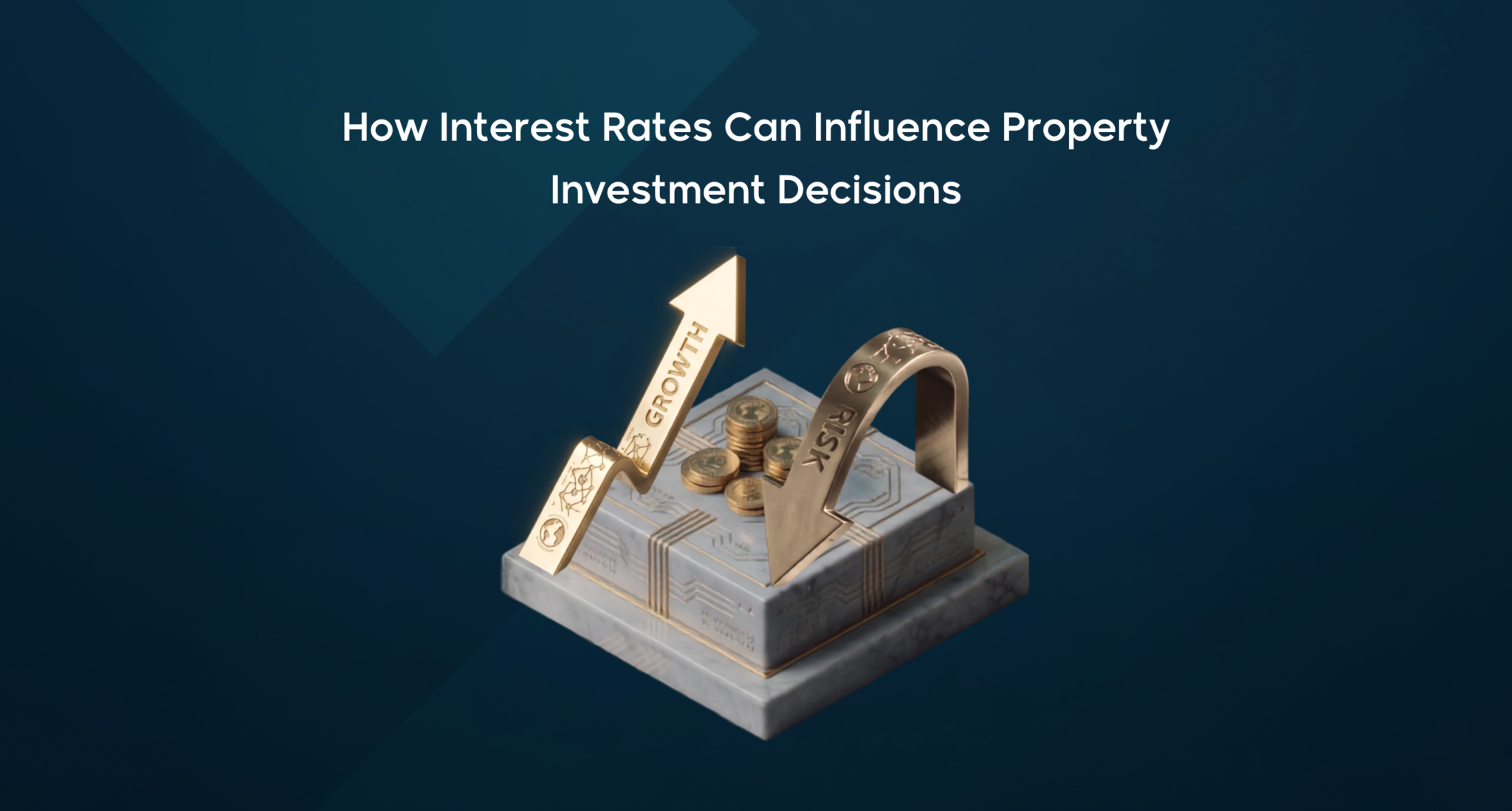
Interest rates certainly influence the property market, but they are only one part of a much bigger picture. Employment levels, housing supply, population growth, consumer confidence, rental demand, and broader economic conditions all play a role in determining how the market performs. Looking at interest rates in isolation can sometimes create a misleading view of what’s really happening.
Successful investors understand that interest rate movements provide valuable information, but they don’t make investment decisions based on a single economic indicator. Instead, they consider how changing interest rates fit into the wider market and whether an investment continues to support their long-term financial goals.
What Are Interest Rates and Why Do They Matter?
Interest rates represent the cost of borrowing money. They influence everything from personal loans and mortgages to business financing and savings accounts, making them one of the most closely watched economic indicators in any country.
When borrowing becomes more expensive, individuals and businesses may think more carefully before taking on new debt. When borrowing becomes cheaper, financing larger purchases often becomes more accessible. These changes can affect consumer spending, business investment, and demand across many sectors of the economy, including real estate.
This is why interest rates and property investment are so closely connected. Property purchases often involve financing, and changes in borrowing costs can influence both buyers and investors. A higher interest rate environment may affect affordability for some purchasers, while lower borrowing costs may encourage greater activity in the property market.
At the same time, interest rates don’t affect every investor in exactly the same way. Some purchase property without borrowing, while others finance only part of an investment. Commercial property, residential property, and fractional ownership opportunities may also respond differently depending on market conditions and investor demand.
Understanding how interest rates and property investment interact is less about predicting exactly what the market will do next and more about recognising how one economic factor influences broader investment decisions.
How Interest Rates Influence Property Investment
Changes in interest rates can influence the property market in several ways, often at the same time.
One of the most obvious effects is on borrowing costs. As financing becomes more expensive, some buyers may reduce their budgets or postpone purchasing decisions altogether. Developers may also become more cautious about launching new projects if financing costs increase significantly.
Interest rates can also influence investor behaviour. During periods of lower borrowing costs, some investors may see greater opportunities to finance property purchases, potentially increasing demand in certain parts of the market. When rates rise, investment decisions may become more selective as investors place greater emphasis on expected returns and long-term value.
Rental markets can also be affected. If some potential buyers decide to delay purchasing a home because borrowing has become more expensive, demand for rental properties may increase. In some markets, this can create opportunities for investors focused on generating rental income rather than relying solely on capital appreciation.
Rather than assuming higher or lower interest rates automatically produce a particular outcome, it’s more useful to think about how different parts of the market respond. Property is influenced by multiple factors working together, and interest rates and property investment should always be viewed within that wider context.
Why Higher Interest Rates Don’t Always Mean Property Prices Fall
One of the biggest misconceptions among new investors is that rising interest rates always lead to falling property prices. While higher borrowing costs can reduce demand in some circumstances, the reality is often far more complex.
Property markets are shaped by local conditions as much as national economic trends. A city experiencing strong employment growth, population increases, or limited housing supply may continue to see healthy demand even when interest rates rise. Likewise, areas with weaker demand may experience slower growth regardless of whether borrowing costs are increasing or decreasing.
Investor confidence also plays a role. Long-term investors often recognise that economic conditions change over time and avoid making decisions based solely on a single interest rate announcement. Instead, they focus on whether a property continues to offer strong fundamentals, such as desirable locations, reliable rental demand, and realistic long-term growth potential.
Changes in financing costs can also make understanding investment performance even more important. Our article “What Is Rental Yield and Why Does It Matter to Property Investors?” explains how rental yield helps investors evaluate the income potential of a property, particularly when borrowing costs and overall investment returns are changing.
Ultimately, interest rates and property investment should never be viewed through a single headline. They form one part of a much broader economic picture, and understanding that bigger picture often leads to better investment decisions than reacting to short-term market news.
Looking Beyond Interest Rates When Evaluating Property
While interest rates receive plenty of attention, they should never be the only factor influencing an investment decision. A property purchased solely because borrowing costs are low may still underperform if it’s in an area with weak demand or limited long-term growth potential. Likewise, a quality investment opportunity doesn’t automatically lose its appeal simply because interest rates have increased.
This is why experienced investors look beyond the headlines and evaluate the bigger picture. They consider factors such as location, rental demand, local infrastructure, employment opportunities, and future development plans alongside broader economic conditions. These fundamentals often have a lasting influence on a property’s performance long after individual interest rate decisions have been forgotten.
A good example is rental demand. Even when borrowing costs rise, people still need places to live. In some cases, higher mortgage costs may encourage more people to rent for longer, supporting demand for well-located rental properties. While every market is different, this illustrates why interest rates and property investment should always be considered within the wider context of supply, demand, and local market conditions.
If you’re learning how to identify properties with strong long-term potential, our article “What Makes an Investment Property Location Attractive?” explores the characteristics investors commonly look for when evaluating real estate opportunities.
Investors who want to better understand how interest rates are managed in Saudi Arabia can also refer to the Saudi Central Bank (SAMA), which publishes official information on monetary policy, benchmark interest rates, and the Kingdom’s financial system. Understanding the broader economic environment can help investors place interest rate changes into context rather than reacting to individual announcements.
How Fractional Property Ownership Supports Long-Term Investors
One challenge many investors face is deciding when to enter the property market. Waiting for lower interest rates may seem sensible, but delaying an investment also means postponing the opportunity to begin building a long-term portfolio.
Fractional property ownership provides another way of approaching interest rates and property investment. Instead of focusing entirely on the cost of purchasing a whole property, investors can gain exposure to income-generating real estate by owning a share of an asset. This allows many people to begin investing sooner while continuing to build a diversified portfolio over time.
Of course, every investment should still be evaluated carefully. Rental demand, expected returns, location, and the quality of the underlying asset remain just as important as broader economic conditions. Interest rates may influence the investment landscape, but they should never replace thorough research and careful planning.
If you’re new to this investment approach, our article “Understanding Fractional Property Ownership in Saudi Arabia” explains how fractional ownership works and why it has become an increasingly accessible way for investors to participate in income-generating real estate.
At Osool Gamma, we believe informed investors make better long-term decisions. Understanding interest rates and property investment is an important part of that process, but it is only one piece of a much larger picture. Through investor education and access to fractional property ownership opportunities, Osool Gamma helps investors build confidence while developing investment strategies that align with their financial goals. Where applicable, Osool Gamma’s offering is currently being tested within REGA’s Regulatory Sandbox, supporting innovation in Saudi Arabia’s evolving real estate investment sector.
Putting Interest Rates Into Perspective
Interest rates will always influence the property market, just as inflation, employment, and economic growth do. The challenge for investors is not trying to predict every change but understanding how these factors work together.
Successful property investing is rarely built on reacting to a single announcement or waiting for perfect market conditions. Instead, it comes from evaluating opportunities carefully, understanding local market fundamentals, and maintaining a long-term perspective that reflects your financial goals.
When viewed in isolation, changes in borrowing costs can appear dramatic. When viewed as one part of a broader investment strategy, however, they become another factor to consider rather than a reason to abandon well-researched investment decisions.
By understanding the relationship between interest rates and property investment, investors are better equipped to make thoughtful decisions based on research, planning, and long-term objectives instead of short-term market sentiment.
Frequently Asked Questions
Do Higher Interest Rates Always Cause Property Prices to Fall?
No. While higher interest rates can influence borrowing costs and demand, property prices are also affected by factors such as housing supply, population growth, employment, rental demand, and local market conditions.
Why Are Interest Rates Important for Property Investors?
Interest rates and property investment are closely connected because borrowing costs can influence affordability, investor demand, and financing decisions. However, they should always be considered alongside other market fundamentals.
Should I Delay Investing Until Interest Rates Fall?
Not necessarily. Waiting for lower interest rates may mean delaying your long-term investment plans. Many experienced investors focus on the quality of the investment, their financial goals, and market fundamentals rather than trying to predict future interest rate movements.