

Most investors eventually reach the same question when building a real estate portfolio:
Where should I actually place my money?
For some people, residential property feels like the safer option. Housing demand tends to remain steady, the market feels familiar, and the long-term outlook often feels easier to understand. For others, commercial property looks more attractive because of the potential for higher rental income and exposure to business growth.
Neither side is necessarily wrong.
The reality is that residential and commercial real estate serve different purposes within a portfolio. The better choice usually depends less on what is “best” overall and more on what fits an investor’s financial goals, risk tolerance, and long-term strategy.
That conversation is becoming increasingly relevant in Saudi Arabia as fractional property ownership continues growing.
Shared ownership models are making it easier for investors to access different property sectors without purchasing entire assets independently. Instead of committing all available capital to one property, investors can now spread exposure across multiple opportunities more flexibly.
For many investors, that changes the conversation completely.
Instead of asking:
“Can I afford this property?”
The question becomes:
“What type of property exposure actually makes the most sense for my portfolio?”
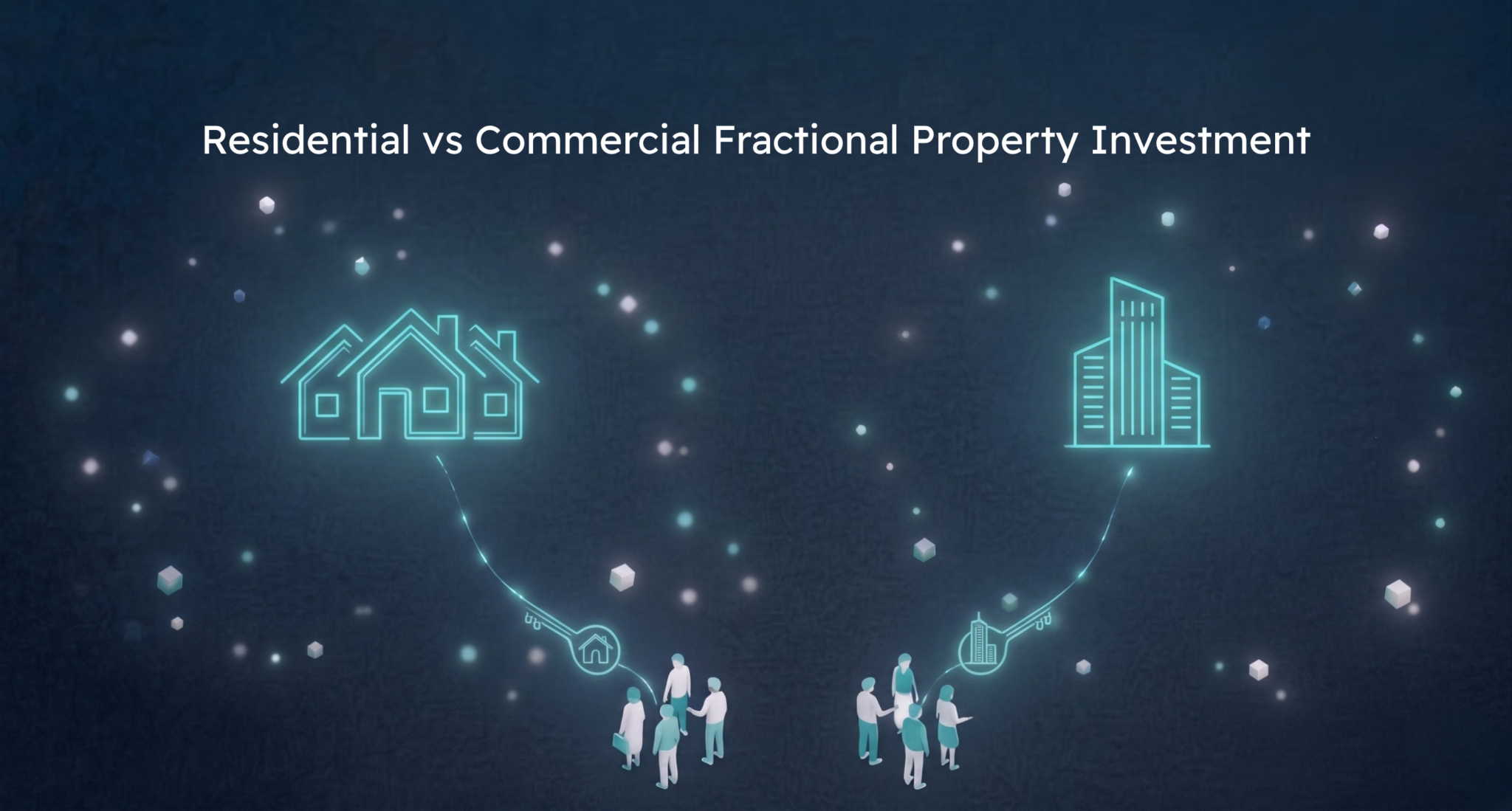
This article explores the differences between residential and commercial fractional property investment, how each sector behaves, and what investors should think about before deciding which approach better suits their long-term financial objectives.
Why Property Type Matters More Than Many Investors Realise
Not all real estate performs the same way.
Some properties are designed around stability and predictable demand, while others are more closely tied to business activity, economic growth, or infrastructure development.
That distinction matters because different sectors often behave differently during changing market conditions.
As an investor, understanding those differences can help shape:
- income expectations,
- portfolio stability,
- long-term growth potential,
- and overall risk exposure.
This becomes even more important when building a diversified portfolio rather than relying on a single asset.
Residential Property Often Appeals to Stability-Focused Investors
Residential real estate is usually the starting point most people feel comfortable with.
Apartments, villas, and housing developments tend to feel easier to understand because people interact with residential property constantly in everyday life. Most investors already have a basic understanding of how housing markets behave, even before they begin investing.
That familiarity creates confidence.
Housing Demand Tends to Remain More Consistent
One reason many cautious investors prefer residential property is because housing demand tends to remain relatively stable over time.
People will always need places to live, particularly in growing urban areas where population growth and infrastructure expansion continue driving demand.
That does not mean residential property is risk-free, but it can sometimes feel more predictable than commercial sectors that depend heavily on business activity.
For investors focused on:
- long-term stability,
- consistent occupancy,
- and lower volatility,
Residential exposure may feel more aligned with their goals.
Residential Investments Can Feel Less Intimidating
For newer investors, especially, residential opportunities often feel more approachable.
Commercial real estate can sometimes seem complicated because it involves:
- business tenants,
- lease structures,
- sector-specific performance,
- and broader economic sensitivity.
Residential property tends to feel simpler by comparison.
That psychological comfort matters more than many people realise when investors are making long-term financial decisions.
Commercial Property Attracts Investors Looking for Stronger Growth or Income Potential
Commercial real estate usually appeals to investors who are more comfortable taking on additional market exposure in exchange for potentially stronger returns.
This may include:
- office spaces,
- retail properties,
- logistics facilities,
- hospitality assets,
- and mixed-use developments.
For some investors, commercial opportunities feel more attractive because of the income potential associated with business-focused assets.
Commercial Assets Can Produce Stronger Yields
Commercial properties may sometimes generate higher rental yields compared to residential assets, particularly when linked to strong economic activity or infrastructure growth.
For income-focused investors, that can be appealing.
However, stronger income potential often comes with greater sensitivity to market conditions.
Commercial sectors may react more sharply to:
- economic slowdowns,
- business performance,
- tourism fluctuations,
- or changing consumer behaviour.
That is the trade-off many investors consider carefully.
Commercial Property Is Often More Cyclical
Unlike residential housing demand, commercial performance is often tied more directly to economic activity.
For example:
- Retail spaces depend heavily on consumer spending,
- Office demand may shift alongside business growth,
- And hospitality assets often rely on tourism performance.
For investors with higher risk tolerance, that volatility may feel acceptable if the long-term growth opportunity is strong enough.
For more cautious investors, residential exposure may still feel more comfortable overall.
Fractional Ownership Changes the Way Investors Approach Both Sectors
One of the biggest reasons this discussion is changing is that fractional ownership creates more flexibility.
Traditionally, investors often had to commit large amounts of capital to a single property category. That made diversification difficult.
Shared ownership structures allow investors to think differently.
Instead of choosing one property and hoping it performs well long term, investors can spread exposure across:
- residential opportunities,
- commercial assets,
- logistics developments,
- and mixed-use sectors simultaneously.
That flexibility changes portfolio construction completely.
Investors No Longer Need to Think in Absolutes
Many investors no longer feel forced to choose:
- only residential,
- or only commercial.
Instead, they can build portfolios that balance:
- stability,
- income generation,
- growth potential,
- and risk exposure.
For example:
- Residential assets may provide portfolio stability,
- while commercial exposure may offer stronger income potential or long-term growth opportunities.
That balance often creates a more resilient long-term strategy.
Risk Tolerance Plays a Bigger Role Than People Expect
Two investors looking at the exact same opportunity may view it completely differently.
One person may see:
- strong growth potential,
- high demand,
- and attractive returns.
Another may focus on:
- volatility,
- economic sensitivity,
- and uncertainty.
Neither perspective is necessarily wrong.
Investment decisions are heavily influenced by:
- financial goals,
- personality,
- experience,
- and comfort with risk.
That is why understanding your own investment mindset matters just as much as understanding the property itself.
Some Investors Prioritise Stability Above All Else
For some people, protecting capital and maintaining consistency matters more than maximizing potential returns.
These investors may naturally lean toward:
- residential exposure,
- stable occupancy,
- and lower volatility.
Others may feel comfortable accepting more market fluctuation in exchange for:
- stronger yields,
- business growth exposure,
- or long-term infrastructure opportunities.
Understanding where you fall on that spectrum is important before allocating capital.
Diversification Is Becoming a Major Priority for Saudi Investors
One of the clearest shifts happening across modern investing is the growing focus on diversification.
Investors are becoming more aware of the risks associated with concentrating too much money into one sector or one asset.
Fractional ownership supports diversification particularly well because it allows investors to spread exposure more flexibly across different opportunities.
For many investors, that flexibility is one of the biggest advantages of shared ownership models.
Portfolio Balance Often Matters More Than Chasing Maximum Returns
Experienced investors rarely focus only on finding the highest possible return.
More often, they focus on:
- sustainability,
- consistency,
- risk management,
- and long-term portfolio quality.
A balanced portfolio combining both residential and commercial exposure may feel more practical than relying entirely on one category.
Transparency and Management Quality Still Matter
Regardless of sector, strong investment performance still depends heavily on:
- asset quality,
- management standards,
- tenant demand,
- and operational transparency.
Shared ownership structures improve accessibility, but investors still need to evaluate opportunities carefully.
Some products and services within this sector may currently be tested within REGA’s Regulatory Sandbox as modern ownership structures continue evolving within Saudi Arabia.
For many investors, transparency and operational credibility are becoming just as important as the property itself.
How Osool Gamma Supports Fractional Property Ownership
As investor interest in shared ownership opportunities continues growing across Saudi Arabia, accessibility and professionally managed opportunities are becoming increasingly important.
Osool Gamma operates within this evolving investment environment by supporting participation in fractional property ownership opportunities across different real estate sectors.
Rather than requiring investors to commit entirely to a single property independently, shared ownership structures can support broader diversification and more flexible portfolio allocation.
For investors comparing residential and commercial exposure, professionally managed opportunities may provide a more accessible way to participate in Saudi Arabia’s growing real estate market while building a more balanced long-term portfolio.
Conclusion
Residential and commercial fractional property investment each offer different advantages depending on the investor’s goals, priorities, and comfort with risk.
Residential opportunities are often associated with stability, familiarity, and consistent demand. Commercial assets may offer stronger income potential and greater exposure to economic growth, but they can also involve more market sensitivity.
For many investors, the decision is no longer about choosing one sector entirely over the other.
Fractional ownership is creating more flexibility in how investors build portfolios, allowing them to balance:
- stability,
- growth,
- income potential,
- and diversification
more strategically.
As Saudi Arabia’s real estate market continues evolving, investors are increasingly approaching property exposure as part of a broader long-term portfolio strategy rather than simply purchasing individual assets independently.
FAQ
What is the difference between residential and commercial fractional property investment?
Residential investments involve housing-related properties such as apartments or villas, while commercial investments may include offices, retail spaces, logistics facilities, or hospitality assets.
Which property type is considered more stable?
Residential property is often viewed as more stable because housing demand tends to remain relatively consistent over time.
Can commercial property generate higher rental income?
Commercial properties may sometimes offer stronger rental yields, although they can also be more sensitive to economic conditions and market fluctuations.
Can investors diversify across both sectors?
Yes. One of the advantages of fractional ownership is the ability to spread exposure across multiple property sectors and opportunities more flexibly.
Is fractional ownership becoming more popular in Saudi Arabia?
Yes. Growing interest in diversification, accessibility, passive income, and professionally managed opportunities is contributing to increased attention toward shared property ownership models across Saudi Arabia.